

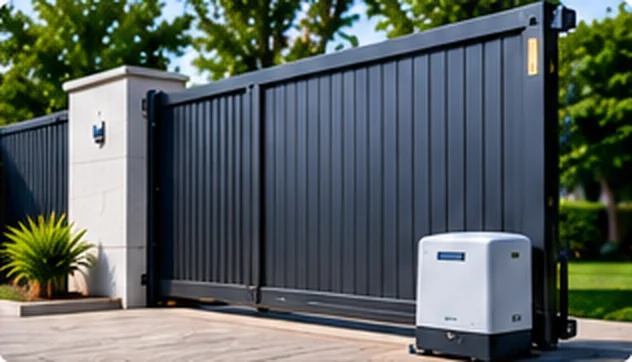
If your main gate still needs someone to get out of the car in the rain, or you worry about who can push it open, it is time to automate it. The first decision is not the brand or the remote — it is sliding or swing. Both open your gate with a remote, a phone or an intercom, but they move in completely different ways, and the right choice depends on your driveway, your ground, and how the gate is used every day.
The second question everyone asks is the price. There is no single fixed price, because it depends on the size and weight of your gate, the motor it needs, and whether you want battery backup. The only way to get an exact price is a free site survey — which we do in Faisalabad, Islamabad, Lahore, Okara, Sahiwal, Multan and Toba Tek Singh.
1. How a sliding gate works
A sliding gate is one wide panel that rolls sideways along a track, usually on a rail set into the driveway, and parks against the boundary wall when open. It needs clear space to one side of the entrance — roughly the full width of the gate — but it needs almost no depth in the driveway itself. That makes it the natural choice for short driveways, wide entrances, and homes where cars park close behind the gate. It also handles slopes well: the panel runs on its track instead of swinging uphill. The trade-off is the track — it has to be kept clear of mud and stones, and the foundation under it has to be solid, or the gate will start to drag.
2. How a swing gate works
A swing gate is usually two leaves on hinges that open inwards, like double doors. It is the classic look most homes in Faisalabad already have, and it is quieter and simpler in daily use — no track to clean, and if the power goes out you can push a leaf open by hand more easily. The price is space: the leaves need a clear arc inside the driveway to swing open, so you cannot park a car right behind the gate, and the ground inside has to be level — a leaf that has to swing uphill will scrape and strain its hinges. Swing gates suit homes with a deeper driveway and a flat entrance.

3. Space and slope: the two deciding factors
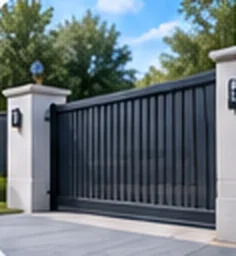
Before choosing, measure two things. First, the side space: is there a clear run of wall, at least as wide as the gate, for a sliding panel to park against? If the boundary wall is short or has a pillar in the way, sliding is out. Second, the swing space: is there a clear arc inside the driveway, as deep as the gate is wide, with flat ground? If cars park there or the ground rises, swing is out. In our surveys, this two-minute check decides most jobs — everything else is detail. A gate that is wide and heavy also pushes towards sliding, because one motor moving a panel on a track copes with weight better than two arms pushing heavy leaves.
4. Security, power and daily use
On security, a sliding gate is slightly harder to force open — the panel locks into its track and there is no gap to lever. A swing gate is easier to push open by hand when unlocked, which is a plus in an emergency and a minus if someone tries. Both can be locked electrically, opened from a remote, a phone app or a video intercom, and both should have safety sensors that stop the gate if a child, a car or a pet is in the way — never skip the sensors. On power, both need a backup: during load shedding, a battery keeps the gate working, and a manual release key lets you open it by hand if the battery ever runs flat. Ask for the backup before you agree the job, not after.
5. Mistakes to avoid
The most common mistake is a motor that is too small for the gate — it works for a few months, then burns out, and the warranty does not cover it because the gate was heavier than the motor was rated for. The second is a cheap no-name motor with no warranty and no local support: when the remote stops working, nobody answers. The third is skipping the foundation — a sliding track laid on loose ground, or swing hinges fixed to a weak pillar, will shift and jam within a year. And the fourth is no battery backup, so the gate is dead every time the power goes. A right-sized motor with a proper warranty, a solid foundation, safety sensors and a battery — in that order — is what makes a gate last.
6. How installation works with us
Every job starts with a free site survey. We visit your home, factory, school or office in Faisalabad, Islamabad, Lahore, Okara, Sahiwal, Multan or Toba Tek Singh, measure the gate and the ground, check the power point, and recommend sliding or swing in writing — with the motor size, the backup and the price, before any work starts. Then our team installs the motor, track or hinges, remotes and sensors, connects it to your intercom or phone if you want, and tests the safety stop with you watching. After the job, we stay available for support, and our annual maintenance contracts (AMC) cover check-ups, oiling and adjustments so the gate keeps running smoothly year after year.
Tell us whether your gate is sliding or swing, or simply book a free site survey and let us measure it. Call or WhatsApp +92 303 5737242 or +92 333 6766320, or get a free quote from our contact page. Our gate automation service covers homes, offices, factories and housing societies.